
 Tutorials


 Ahura
Ahura Plugins

 Blog
BlogHow Much Does Content Production Cost? 2 Ways to Pay for Content
- Tutorials
- Updated on

when you want to produce content for your business, the first question that pops into your head is, “Okay, how much is this going to cost me?” And you’ve got every right to ask. Content production is one of those monthly expenses that, if you’re not paying attention, will either have you overpaying or leaving you stuck with low-quality content that gets you nowhere.
In this article, we’re going to keep things simple and straightforward. First, we’ll look at the factors that determine the price of content. Then we’ll take a look at market rates, and finally we’ll open up that famous fork in the road: how to pay for content production in a way that’s both cost-effective and actually delivers results. So let’s get started.
Table of Contents
Factors That Affect the Cost of Content Production
Before we get into actual numbers, it’s worth knowing what actually influences the price of your content. Because once you understand these things, nobody can pull a fast one on you.
The topic — the single most important factor
The topic has the final say. A general piece like “10 Tricks for Tidying Up Your Home” is much easier and cheaper to write than a specialized article on “Security Protocols in Blockchain Networks.” The more specialized the topic, the more time the writer has to put in, the more research they have to do, and sometimes they even have to learn something themselves. So naturally, the price goes up.
The type and style of content
Exactly what kind of content you want also has a big impact on the price. A simple post for your business blog is usually cheaper than a sponsored advertorial. Now put that alongside the difference between text, video, audio, photo, or motion graphics content. Each one is its own world, and naturally their pricing differs too.
How pricing is calculated
Here’s a general rule of thumb worth knowing:
- Audio, video, and motion graphics are usually priced by the minute.
- Text and written content is priced by the word.
- Photography is priced per shot.
One small note: SEO-optimized text (content that’s been optimized to rank on Google) has a different price than regular written text. So when you place an order, be specific about exactly what you want.
Different Content Production Rates on the Market
There are plenty of people and companies working in the content market, and each one quotes a different price. To keep you from getting confused, let’s break them into categories:
Personal brands
Some people have a real name for themselves in their field — they have experience, they’ve done their reading, and their writing is well known. You can’t price these folks by the word anymore, because what they’re selling isn’t just “text” — it’s their credibility and expertise too.
Freelancers
Freelance writers who work independently and have developed their skills in content marketing. This group usually charges the lowest rates and is a good option for getting started or for limited projects. At the entry level, per-word rates commonly fall somewhere around $0.05 to $0.10 per word.
Quantity-focused agencies
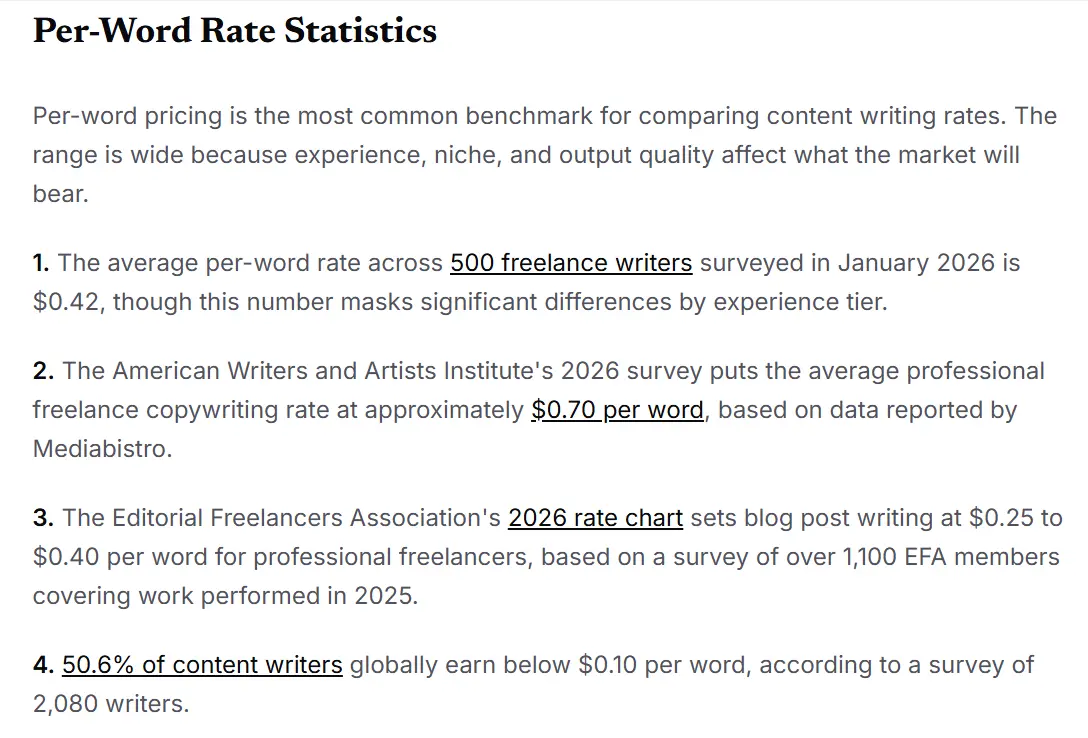
Some companies build their strategy around “lower price, higher volume.” The quality of their work depends directly on which writer ends up handling your project. Rates at these companies typically run somewhere in the range of $0.03 to $0.10 per word.
Quality-focused agencies
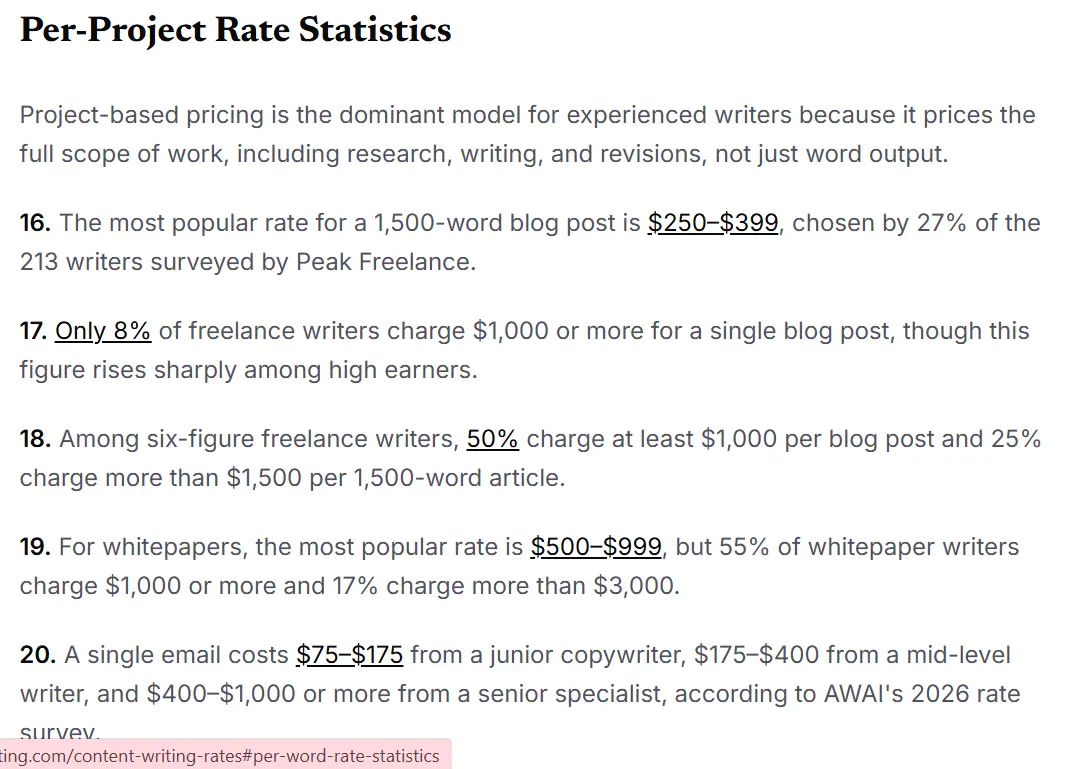
These play a different game. Their strategy is higher quality and brand building, and their clients are people and organizations with long-term plans. Rates at these companies move somewhere between $0.20 and $1.00+ per word — and for highly specialized niches like legal, finance, or healthcare, expert rates can climb even higher.
Heads up: these figures are drawn from industry rate surveys and service providers around 2025–2026. The content market changes very fast, so be sure to ask for current rates before making a decision.
The Cost of Written Content
Okay, we’ve reached the question that’s been on so many people’s minds. As we said, the exact number depends on the topic, type, and amount of content. But let’s paint a general picture:
If you want to order a roughly 1,000-word article for your blog, the cost comes out somewhere between $75 and $500. For that same word count, if you want a sponsored advertorial, it usually runs somewhere between $100 and $600. And in general, per-word content pricing moves up and down within a range of up to around $1 per word (and even higher for top-tier specialists). (These figures reflect market rates around 2025–2026.)
Factors that affect the price of written content
The price of a piece of text isn’t set arbitrarily. There are a few main factors behind it:
- The quality of the content writer’s work: this is the most important one.
- The length of the content: the longer it is, naturally the more it costs.
- The writer’s experience and brand: someone who’s worked for years and built a name for themselves is more expensive — and worth it.
- How specialized the text is: the more specialized the topic, the higher the price.
Two Ways to Pay for Content Production
Okay, now we’re getting to the heart of the matter. In today’s world, no business can stay on its feet without an online presence and good content. Now the question is: how do you pay for this content? This is exactly where you find yourself at a fork in the road. Let’s open up both paths so you can decide which one suits your business.
Option one: Hiring a content writer (fixed payment)
With this approach, you hire someone to produce content for you on a full-time or permanent basis — whether for your website, Instagram, or LinkedIn.
Sounds good, right? But hold on. This approach comes with some hidden costs:
- You have to pay a fixed salary, benefits, and insurance.
- You have to set up office space and equipment for them.
- If your workload goes up, one person might not be able to handle it all at a high quality.
- And most importantly, no writer is a master in every field. Someone might be great at medical topics but fall short on technical ones.
So this approach can end up being more expensive in the long run than you’d think.
Option two: Outsourcing content production (project-based payment)
With this approach, instead of hiring, you hand your work over to a specialized team or agency and pay on a project basis.
Look at the advantages:
- You don’t get caught up in the headaches of hiring, salaries, benefits, and office space.
- You have access to a team of writers who specialize in different fields, not just one person.
- You receive content that’s been optimized according to SEO principles.
- And overall, your content production cost comes out lower.
The best option for you
The short answer: it depends. If you have a large business that needs a high volume of content daily and you want full control over the entire process, hiring might make sense. But for most businesses — especially small and medium ones — outsourcing is both more cost-effective and less of a hassle. You work with an expert team, you only pay for the work that’s actually done, and you can rest easy about quality and SEO.
The Difference Between a Content Writer and a Copywriter
This question is exactly like asking what the difference is between a taxi driver and a race car driver!
A content writer takes the topic you give them, does the research, and writes a good, engaging piece. They know their craft.
But a copywriter is a step ahead. A copywriter is someone who can advertise within the content itself, give the audience cues, and ultimately turn a simple piece of text into a sales tool. This person can literally make you money with their writing. In fact, copywriters are a kind of content strategist. So if your goal is just to inform, a content writer is enough — but if you’re after sales and turning your audience into customers, go for a copywriter.
A Common Mistake That Drives Up Costs
The simplest thing a lot of people do is this: they get quotes from a few companies and freelancers and pick the cheapest one. Done. It sounds logical, but in practice it’s a trap.
With this approach, because you’re only chasing a low price, you don’t stop to think about what value each piece of content is supposed to create. The result is mass production of aimless content that:
- First, because of its low quality, has no effect on the audience and doesn’t get you any results.
- Second, because of the lack of proper planning, it causes duplicated effort and a problem called keyword cannibalization — meaning several pages on your own site compete over the same keyword and hurt your ranking on Google.
So this “cheap” option actually ends up being very expensive.
How Do You Actually Cut Costs With a Content Strategy?
The right, professional approach is to stop thinking about “price” and focus instead on “smart cost management and reduction.” In other words, have a content strategy where every piece of content you produce pursues a specific goal and has its place in the bigger puzzle.
Here are the practical steps:
- Define your business goals for content marketing.
- Get to know your audience carefully.
- Use keyword research to figure out what your audience is looking for.
- Identify and analyze your SEO competitors.
- By categorizing keywords, choose specific topics for content production.
- Do topic clustering for each area.
- Set up an editorial calendar for regular production and publishing.
- Design landing pages for your important topics.
- Optimize the content of those landing pages based on keywords.
- Strengthen those pages by producing topical content and building internal links.
When you go about it this way, you stop wasting your money on aimless content, and every piece you produce brings you a real return.
Wrapping Up
Look, the cost of content production isn’t a fixed number — it depends on the topic, the type of content, and the writer’s quality and experience. And to pay for it, you have two main paths: either hire a permanent writer, or outsource your work on a project basis, which for most businesses is the more cost-effective and less stressful option.
But the most important takeaway from this article is this: instead of looking for the cheapest option, look for the smartest one. With the right content strategy, the very money you spend comes back to you several times over. That’s it. Take care and all the best. 🙂

Ahura WordPress Theme
The Power to Change EverythingElementor Page Builder
The most powerful WordPress page builder with 100+ exclusive custom elements.
Incredible Performance
With Ahura’s smart modular loading technology, files load only when they are truly needed.
SEO Optimized for Google
Every line of code is carefully aligned with Google’s algorithms and best practices.

To post a comment, please register or log in first.