Almost anyone who enters the world of content creation—whether working on YouTube, running a blog, or being active on Instagram and a personal website—eventually reaches a point where they ask, “Okay, what should I create now?” This feeling becomes even stronger, especially if you’ve been consistently producing content for years.
In this article, I want to share methods with you that work whether your website has just been launched and doesn’t yet have much content, or whether, like ours, it has been filled with videos and articles after years of work. In both cases, you can find fresh ideas for creating content and prevent your site from falling into stagnation.
Almost anyone who enters the world of content creation—whether they work on YouTube, run a blog, or are active on Instagram and a personal website—eventually reaches a point where they ask, “Okay, what should I create now?” This feeling becomes even stronger if you’ve been producing content consistently for years.
Table of Contents
Content Creation Ideas for a Website
I’ve had this exact experience myself. When I look back, I see that I’ve recorded over seven hundred educational videos just in the field of WordPress, not even counting the other articles and written tutorials. On the Mihan WordPress website, more than two thousand five hundred free educational articles have been published, and I can say that almost everything that ever came to mind about the WordPress world has been covered somewhere—either in a video or in a written article.
So when you reach a point like this, the first thought that comes to mind is that there’s nothing left to say. I’ve felt this many times. I sat in front of my laptop, wanting to record a new video or write a fresh article, but honestly, nothing came to mind. This feeling is very strange and even frustrating because in content creation, stagnation equals death. When you don’t have ideas, production gradually stops, the site is no longer updated, search engines lose interest in you, and eventually your audience becomes discouraged.
That’s when I told myself I needed to find a solution for this problem. I was sure I wasn’t the only one experiencing it. Every content creator eventually reaches a point where their mind just locks up. So I started examining methods that could reignite my mental engine.
The result of that research was several very simple yet practical techniques for finding new ideas. I’ve tested these techniques many times—both on my own website and for those who receive content creation consulting—and interestingly, they have always worked.
The Difference Between Finding Content Ideas for a New Website and a Content-Rich Website
When it comes to finding content ideas, you should always consider the condition of your website. The strategy that works for a newly launched website is completely different from the method suitable for an older site filled with articles. I’ve experienced this many times myself—both when launching a site from scratch and looking for initial article ideas, and when working on Mihan WordPress, with thousands of existing posts and videos, reaching a point where I had to look for new angles for content production.
In the first scenario, when your website has just launched and doesn’t yet have much content, you’ve usually produced somewhere between ninety to a hundred articles or at most a few educational pages. Here, your hands are wide open. The playing field is still untouched, and any simple topic can turn into a full article.
Users who visit your site are looking for basic information, so you don’t need to worry about ideas being repetitive. On the contrary, you should try to cover all the fundamental questions. Every term, every tool, and every question that might seem obvious to you can be an engaging topic for a beginner.
But in the second scenario, things become a bit more complicated. Imagine your site is like Mihan WordPress, which has been updated for years and contains thousands of educational articles and videos. Here, you can no longer go after very basic topics because they’ve already been covered.
In such circumstances, you need to change your perspective. Instead of asking “what” to produce, think about “how differently” you can produce it. A topic may have been discussed many times before, but you can revive it with a new approach, a real example, or even a personal experience. This is what ensures that even on content-heavy websites, there is always room for fresh ideas.
So the main difference between these two situations is this: on a newly established website, basic and fundamental topics are the best ideas. But once your site is filled with articles and tutorials, you need to be more creative—explore comparisons, deeper reviews, and even personal critiques and analyses so that your new content can stand out among all those existing articles.
Scenario One: Newly Launched Websites
The first scenario is when your website has just been launched and you don’t have any content on it yet. Naturally, when there’s no content available, you don’t have any source of inspiration either. This is where you need to look outside for ideas. There are different methods, such as analyzing competitor websites, using SEO tools, getting help from AI tools like ChatGPT, or even using Google search itself and the LSI suggestions that appear while searching.
Using SEO Tools
I usually don’t highly recommend SEO tools for Persian-language websites because the data they provide isn’t always accurate or complete. Even for English websites, sometimes their information isn’t reliable enough to build your entire content strategy solely based on it. However, as a supportive tool for finding content ideas, they can still be very useful.
For example, one of the tools I personally approve of is Neil Patel’s website and the Ubersuggest tool. When you enter a keyword—such as “WordPress” or even “artificial intelligence”—the tool starts showing you terms that are frequently searched in that field. For instance, if you search for “artificial intelligence,” you might see that a phrase like “AI translator” has a high search volume. That alone is an excellent content idea. When you know what users are searching for, you can turn that exact topic into an article or a video.
Neil Patel
In fact, SEO tools act like a roadmap here. They show you which keywords are trending and what people are searching for the most. From that same list, you can extract plenty of topics for content creation. Even if it later asks you to log in to display more details, the initial preview alone is full of fresh ideas.
Using Google Search
The second method that can be very useful for a newly launched website is using Google itself. Just go to google.com and search for a simple phrase. For example, type “how to use artificial intelligence…” As soon as you enter this phrase, Google will start offering different suggestions automatically. You’ll see many topics appear, such as: how to create images with artificial intelligence, how to make videos with artificial intelligence, how to talk using artificial intelligence, how to produce music with artificial intelligence, or even how to create PowerPoint presentations.
Google search
One very important point here is that these Google suggestions do not necessarily mean those phrases have high search volume. At this stage, our goal is not to find the most searched keywords at all. What we need is ideas. These Google suggestions can act like a spark and put dozens of new content topics right in front of you.
It’s better to go after long-tail keywords here. That means longer phrases that answer a specific question. For example, instead of just searching for the word “WordPress,” try phrases like “how to build an online store with WordPress” or “how to localize WordPress into Persian.” This way, Google will give you many more detailed suggestions, each of which can be a separate content topic.
So if one day you run out of ideas and don’t know what to create for your website, just search for a keyword related to your niche in Google and let Google lay out the ideas for you.
Analyzing Competitor Websites
Another one of the best ways to find ideas is by checking out competitor websites. When I first launched Mihan WordPress, I often visited foreign websites like WPBeginner to find new topics. At that time, that site was a reference for me, and almost every time I entered its blog section, I would find lots of fresh ideas.
WPBeginner
For example, I would see that they had written an article about connecting WooCommerce to Amazon. Well, I would take that and turn it into a localized topic and teach on Mihan WordPress how to connect WooCommerce to Digikala. Or for instance, they had published a tutorial about sending WooCommerce order notifications to WhatsApp. I would say, this idea is very useful for Iranian users, so let me create a similar tutorial focused on tools that work in Iran.
I did the same thing with other topics as well. For example, they had written an article about accepting international donations in WordPress. I could take that, adapt it to the conditions in Iran, and produce a more comprehensive tutorial for our own users.
So competitor websites, whether domestic or international, can always be an incredible source of inspiration for content creation. Especially when your site is new and you still have a lot of room to grow, all you need to do is check out these websites, review their topics, and then adapt them to the local needs of your own audience. This way, without having to come up with ideas from scratch, you’ll have plenty of ready-made topics that you can present from a new angle.
Using Google Trends
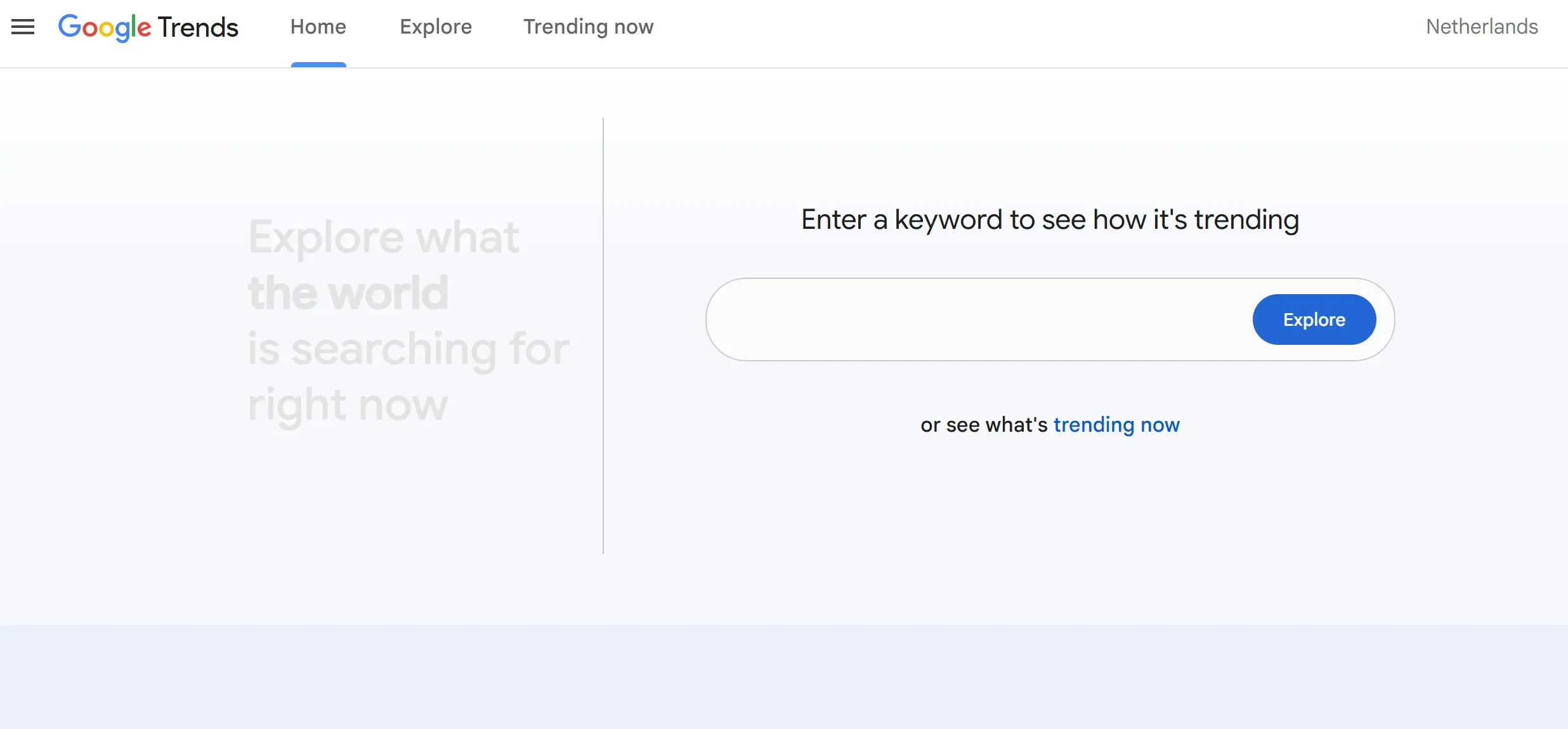
Another tool that can really help you find ideas is Google Trends. Its address is trends.google.com, and it truly works like a goldmine of ideas. All you need to do is search for a simple keyword there, for example, “artificial intelligence.” When you do this, Google Trends shows you which topics and phrases are currently trending the most and what people are searching for.
For example, when you enter “artificial intelligence,”
Google Trends
The big advantage of Google Trends is that it helps you understand what’s hot right now and what people are searching for the most. This method is especially valuable when your website has just launched and you have no user data or traffic. Instead of searching for ideas in the dark, you can clearly see what people are looking for at this very moment.
So when your site is still small and you have no data to analyze, combining tools like Ubersuggest, Google’s own suggestions, reviewing competitors’ websites, and finally Google Trends can act like a complete roadmap for you and provide you with tons of fresh content ideas every day.
Second Scenario: High-Traffic Websites
When your site is newly launched, you need to look outward for ideas. But once you move past that stage and your site starts getting traffic from Google, everything changes. Now you not only have visitors, but you also have a goldmine of data in front of you: the questions, concerns, and feedback your audience gives you every day.
Using User Comments and Questions
At this stage, you no longer have to guess what people are searching for, because they tell you directly. The best source of ideas is the comments and questions they ask in different sections. Just take a look at the comments on your website articles. Wherever someone has asked a question, know that the same question can become the topic of a complete piece of content.
This doesn’t stop at your website. If you have a YouTube channel, the comments under your videos are full of questions—big and small. Audiences tend to ask questions more easily there, and sometimes those questions are even better than the ideas you find in Google Trends or SEO tools. Why? Because they come directly from the user’s real needs.
Instagram is also an amazing source. Your DMs and post comments are always full of questions. Even if the questions are repetitive, they can still be a source of ideas. Why? Because when a question is repeated multiple times, it means the topic truly matters to users. So it’s worth creating a separate article or video about it.
Let me share a personal experience. Many times on Mihan WordPress, I’ve been asked questions that seemed very simple to me—things I thought everyone already knew. But when those same questions were turned into content, they attracted a lot of views. Because there is always a large portion of beginners in your audience who are looking for those seemingly simple answers.
So in this second scenario, when your site is getting traffic from Google and your visits are gradually increasing, the first and best place to look for ideas is these direct user questions and feedback. These are the most real and alive ideas, because they come straight from your audience and are exactly what users are looking for.
Using Analytics Systems Like Google Search Console
When your site is already receiving traffic from Google, it’s time to make the most of the data you have. Unlike the first scenario, where you relied only on external tools, now your own site tells you what users are searching for. The best tool for this is Google Search Console.
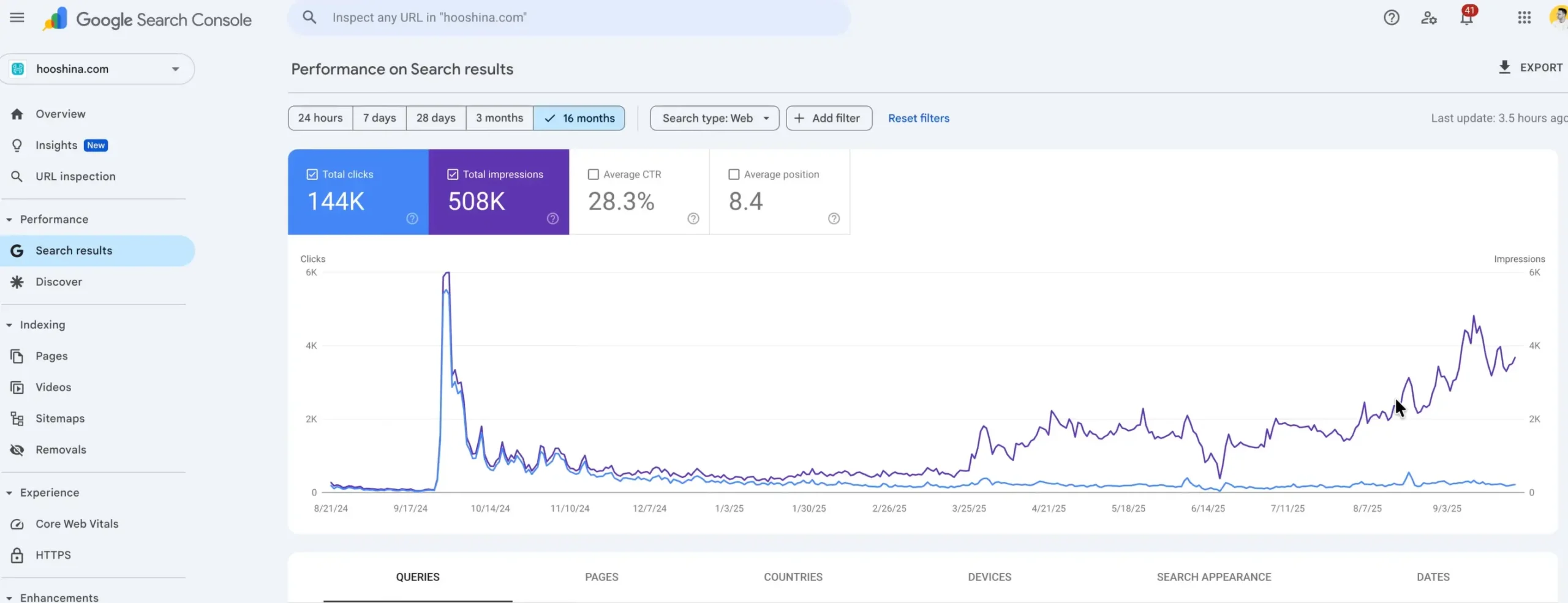
For example, I’ve installed Search Console on the Hooshina website. When I log into its panel, I can clearly see which queries users used to enter the site. Maybe your site currently has only a hundred articles, but even that number can generate several hundred visits from Google daily or monthly. The key point is that even from these limited visits, you can extract many fresh content ideas.
Google Search Console
Search Console has different sections, but one of the parts that is very useful for idea generation is the Insights section. Here, it shows you which content pieces are growing (Trend Up) and which ones are declining (Trend Down). This information is essentially direct guidance for content creation. When you see that one of your articles is growing, you can quickly prepare complementary content or update it so it rises even more. And when it’s declining, it means it needs improvement or rewriting.
On the other hand, in Search Console you can see exactly which queries led users to enter your website. For example, in Hooshina I noticed that one of the phrases bringing good traffic was “AI face photo website.” That alone is a signal. When users come in with such a phrase, it means they’re interested in learning more. So I can quickly create a complete article or video on that topic, or strengthen the page that is currently receiving traffic from that keyword so its traffic can multiply.
Another section you shouldn’t overlook is the click-through rate (CTR). Your ranking on the results page might be good, but you’re not getting clicks. In this case, you should work on your title and meta description and make them more compelling to attract more traffic. Even this simple change can generate ideas. Because when CTR is low, it means the audience hasn’t clearly seen what they’re looking for in the description. So you can write a more comprehensive or more precise article.
In addition to Search Console, other services like Google Analytics or even WordPress statistics plugins (for example, WP Statistics) are also excellent sources for generating ideas. In these tools, you can find out which pages users spend more time on, where they enter from, and which sections they interact with the most. Each of these data points can tell you which topics are more appealing to users and where you should focus more effort.
So the second method—using analytics tools—is actually one of the most reliable and direct ways to find content ideas. Because you no longer have to guess; you have everything in front of you backed by numbers and data.
Reviewing Queries in Search Console
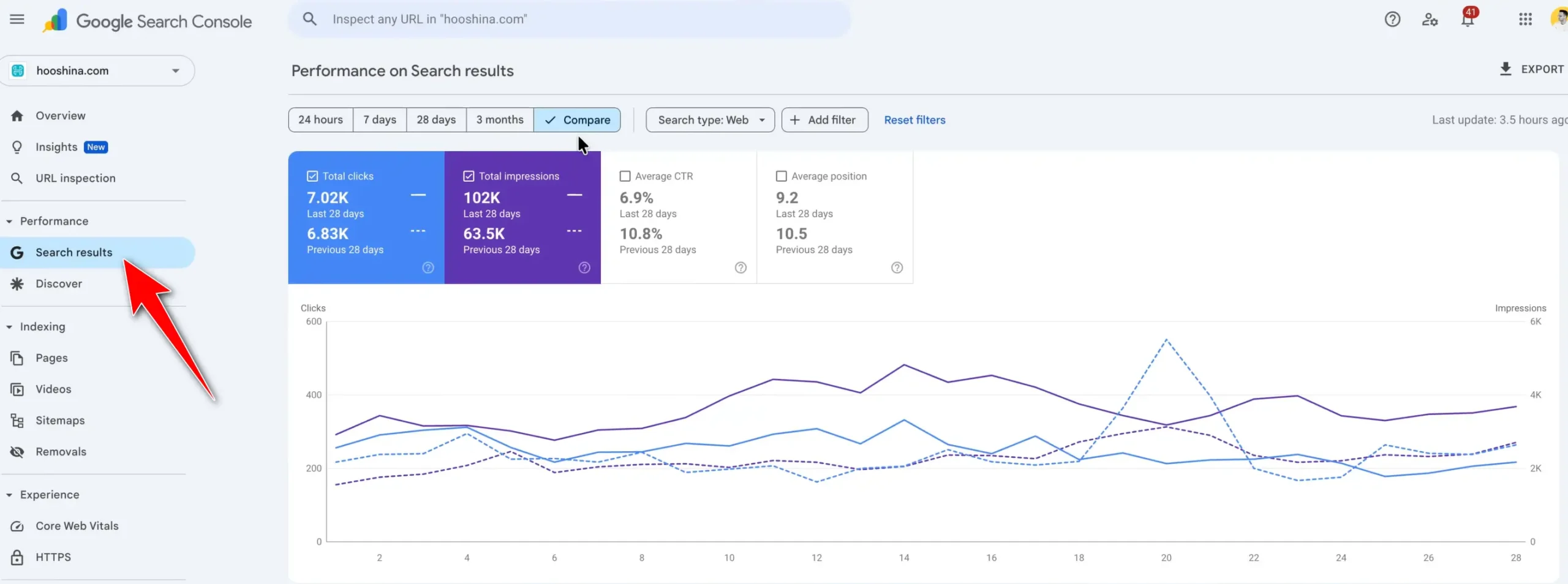
One of the most important sections in Google Search Console is the Search Results report. This section is full of data that can directly tell you which topics have strong potential to become new content.
Search Results
Imagine you enter this section and select the time range for the past three months. Now Search Console shows you which queries have generated high impressions for your website. This means Google users have frequently searched for these phrases, and your site has appeared in the results. However, the key point is that many of these queries have received few clicks.
This is exactly where great ideas are discovered. When users search for a phrase and Google displays your site, but they don’t click on your result, there are two possible reasons: either you don’t have dedicated content for that topic and only briefly mentioned it in one of your articles, or you do have content but your title and meta description weren’t compelling enough.
For example, you might notice phrases like “AI website,” “AI face photo,” or “AI cartoon image” have high impressions but low clicks. These three phrases alone can generate several new pieces of content. You could write a comprehensive guide on “creating images with AI,” or prepare a separate article on “how to create a cartoon image with AI.”
The important point is that this content must not be copied or repetitive. It should be written from a different angle and with more detailed explanations. For example, if you previously had an article about “creating images with artificial intelligence,” you can now produce a new article titled “How to Create Cartoon Images with Artificial Intelligence.” This way, the topics are connected, but fresh content is added to your website.
In fact, Search Console works like a treasure map here. It tells you what your audience was looking for, where you were seen, and why you didn’t succeed in getting clicks. By using this data, you can both create new content and improve your existing content to increase your click-through rate.
Getting Ideas from Artificial Intelligence and Creating a Content Calendar
One of the best methods these days to help you find creative content ideas is using artificial intelligence tools. When I say artificial intelligence, I don’t mean just ChatGPT; there are many other tools as well, such as Google Gemini or even more specialized marketing tools. But to make it more tangible, let’s focus on ChatGPT.
Imagine you have a website in the field of AI education. All you need to do is go to ChatGPT and ask it to create a complete content calendar for you. You can clearly say: “I have a Persian website about AI education. Create a one-month content calendar for me that includes main keywords, long-tail keywords, and article titles.” Now here’s the magic: the AI quickly generates an organized list of topics for you. For example, it may suggest publishing four articles in the first week, producing several videos in the second week, and so on until the end of the month.
This means you no longer need to spend hours searching for ideas. You just need to focus on execution. Of course, you can be even more specific. For example, you could say: “My website is not about education; it’s an online AI image generation service.” Then the model will rewrite the calendar from scratch, and this time the topics will be fully aligned with your new business field.
This is where you truly feel the real power of artificial intelligence. Because it not only gives you a list of topics, but with proper prompting, you can make it suggest content in a much more professional way. You can even ask it to provide the keywords for each piece of content, a suggested meta description, and even the structure of the article itself. This way, before you even start writing, you already have a complete roadmap.
A very important point is that using artificial intelligence does not necessarily mean abandoning other methods. In fact, if you combine this method with the other approaches we discussed, you will achieve the best results. For example, you can first go to Google Search Console and find high-impression queries, then give those keywords to ChatGPT and ask it to create a weekly content calendar based on them. Or you can analyze your competitors’ websites, extract engaging topics, and then ask ChatGPT to expand on those topics and find new long-tail ideas for you.
This combination ensures that you never run out of ideas and always have content to produce. Ultimately, the result of all these efforts is that your website becomes filled with valuable and diverse content. A site where any user who enters can find a proper answer for whatever comes to mind. This, in turn, builds user trust, keeps them on your site longer, and encourages them to come back again.
Final Thoughts
To be honest, after all these years of producing content at Mihan WordPress, we have written articles or recorded videos for almost every idea that has come to our minds. Sometimes, even in the middle of recording a new tutorial, we realized that the same topic had already been published before! This means we have reached a stage where we need to be much more creative in finding new content ideas.
This is exactly where your presence—real users and long-time companions—becomes important. Because no one better than you can tell us what tutorial is needed, what you couldn’t find, or what issue with WordPress still hasn’t been resolved for you. You are the main source of inspiration who can shape the direction of our future content production.
So if you search the site and don’t find the tutorial you need, or if you feel that a certain topic should be explained more thoroughly, let us know in the comments. Rest assured, no idea is unimportant. Every question and every suggestion can turn into a complete piece of content that solves your problem and helps other users as well.
Ultimately, our goal is for Mihan WordPress to always remain a reference where any user who enters feels confident that they can find anything they need about WordPress. With your help, we can continue this journey and create content that is both up-to-date and practical. Stay happy and successful. 🙂
Editorial Staff
This content is produced by the Ertano editorial team. The quality and accuracy of the content have been reviewed and approved by Reza Rad.
Ahura WordPress Theme
The Power to Change Everything
Elementor Page Builder
The most powerful WordPress page builder with 100+ exclusive custom elements.
Incredible Performance
With Ahura’s smart modular loading technology, files load only when they are truly needed.
SEO Optimized for Google
Every line of code is carefully aligned with Google’s algorithms and best practices.

 Tutorials


 Ahura
Ahura Plugins

 Blog
Blog





To post a comment, please register or log in first.