
 Tutorials


 Ahura
Ahura Plugins

 Blog
BlogWhat Is Social Media Marketing? A Guide to SMM and Instagram Marketing
- Tutorials
- Updated on
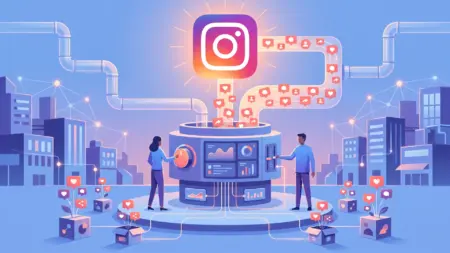
Right now, as you’re reading this, someone out there with 4,000 followers is earning a comfortable full-time living from it, while someone else with 50,000 followers can’t even cover their own phone bill. Where’s the difference? Not luck, not more followers. The only difference is that one of them figured out exactly how social media marketing works, and the other didn’t.
Table of Contents
Social Media Marketing, 500 Years Ago
Here’s the funny part: the heart of this game isn’t new at all. Think of it like something from centuries ago, back when the model that we now dress up with a term like “growth hacking” first appeared in a much simpler form. There was no internet, and nobody had any concept of a social network. The arrangement was straightforward: a landowner would tell people to come work the land and earn their living from it. In the end, the landowner made money and the workers took their share. Look closely and it’s essentially an early version of a self-reinforcing system — one that grows itself.
Now jump to today. After the industrial revolutions, those fields gave way to internet platforms and social networks, and people like Mark Zuckerberg (the founder of Facebook) became the new landowners. But here’s the catch: this land is worth nothing without you and me producing content on it. Exactly like farmland, which without a farmer is just an empty patch of dirt. That person with 4,000 followers has simply figured out how to work the land properly.
Some people use these platforms to show off an attractive lifestyle, some to introduce their pet, and some for marketing. Our conversation is with that last group. This field is called social media marketing. It’s a subset of digital marketing, and two skills serve you more than anything else here: content creation and content marketing. So let’s see how this marketing actually works.
What Is Social Media Marketing (SMM)?
Social Media Marketing — SMM for short — means this: attract an audience, turn that audience into someone genuinely interested, and finally sell to them. And all of it happens through tools like Instagram (one of the biggest platforms in the world) and the other networks.
Any of these activities you carry out on these platforms with the help of content creation and content marketing is, in effect, social media marketing. Most of the activity on these networks happens through content creation — visual, video, or text content. This is the simplest and most accessible way to reach your goal.
Put one principle in your pocket right at the start: audience engagement and the sharing of your content is the beating heart of this work. Picture it — you make one piece of content and millions of people see it. That’s the event you’re chasing.
But before anything else, you need to know exactly how to behave on each network. For example, keep this firmly in mind: on InstagraInstagram and the Different Social Networks
We’re dealing with a whole range of social networks, each with its own mood and character. I want to run through the most important and most popular ones very briefly, so you can pick the one that fits your needs and get started on content creation — whether that’s news, entertainment, or something more personal.
Content Creation and Marketing on Instagram
With well over two billion monthly active users worldwide, Instagram has become one of the most popular networks for marketing and selling, for big and small businesses alike. Features like the story link have let sellers pour their time into creative content and then, with one simple link, sell their product to a large audience.
To be honest, one of my own income streams is offering services and selling educational products on Instagram. That’s why I can say with confidence that you should be on this network too and start earning from it. Just don’t forget that this network is fundamentally entertainment-driven.
To succeed on Instagram, take a few things seriously: build a professional profile, produce engaging and user-friendly content, post gripping stories, write your captions properly, post consistently (across the day and the week), collaborate with influencers both small and large, and take part in contests and campaigns. Get these right and you’ll reach a large, targeted following, and the effect on your goal is genuinely striking.
Twitter (X)
Twitter, or X, still holds its own place despite all its constraints. Its users are especially active in areas like acting, politics, religion, sports, and music, showing up with tweets, text, links, and hashtags. In a word: Twitter is fundamentally a news-driven network.
LinkedIn was built fundamentally to help businesses grow — it’s essentially a B2B network. Its atmosphere is entirely professional, and its main aim is building the right connections between specialists, employers, and managers. This isn’t the place for off-topic chatter; everything revolves around professional growth and advancement.
Facebook is still one of the most visited and useful social networks in the world, with a massive global user base. Keep in mind that thanks to its sophisticated advertising system, it’s one of the best platforms for social media marketing. This network is well suited to building connections between businesses, students, and just about every segment of society.m, whether you like it or not, you first have to entertain the audience. Why? Because nobody opens Instagram to make money. You yourself spend hours on it purely to be entertained. So frame this: the first principle is entertaining the audience.
Marketing Techniques for Instagram and Social Media
The first technique is you! Understand this well: people come to Instagram to see a person — but not the kind of person they see on the street every day. So try to make your content, especially on Instagram, video-based and built around engaging topics. Now let me walk you through a few key skills and techniques that are really the backbone of this work.
Paying for Advertising
One of the core tactics of content creation is focusing on appeal. You might ask: okay, what exactly do I do in a video to make it appealing? If you go looking for the answer, you’ll usually hear the same things: entertain the audience, write a catchy title, make a catchy cover. But the master key to appealing content is something else — the content format.
What Is a Content Format and How Do You Use It?
Any piece of content you make on social media, if it’s going to get lots of views and become popular, needs to follow one of the 12 content formats. Let me name a few examples:
Storytelling, problem-and-solution, and anger-and-forgiveness — among others. The point is that to earn money from these networks, you first have to use professional content to turn your audience into a devoted, die-hard fan.
Using Video and Reels in Your Content Strategy
Attention spans have shrunk and content gets consumed very quickly, which is exactly why you need to make video. Thanks to motion, music, and imagery, video keeps the audience with your content longer and takes more of their time. But don’t get too optimistic; even that video often gets watched only halfway. So to force them to watch your video all the way through, you need to lean on quick-consumption, entertaining content.
Targeted Advertising for a Targeted Audience
One of the biggest mistakes I made early in my own career was thinking that the more followers I had, the more money I’d make. But then I saw a friend of mine pulling in staggering income with targeted advertising and just 4,000 followers, while I couldn’t earn a single cent with my 14,000 followers!
That’s when I realized marketing on social media has to be targeted too, and that we have to find the target audience. To do that, use hashtags, ALT tags, and advertising.
Using Fresh, Up-to-Date Educational Content
After entertaining content, one of the most popular types is educational content. Nobody today has the patience to sit for hours reading a book or working through a lengthy course with a huge syllabus. The modern audience’s motto is: “Give me my content and let me go.”
That’s exactly where the whole thing starts. Why do you think X has a character limit for writing a tweet? Or why stories used to be just 15 seconds and posts one minute? Because every piece of content you make needs to be quick to consume. And to make educational content, you need to raise your own reading level and watch a lot of tutorials on YouTube.
Consistency in Content Creation and Attention to Algorithms
To market on social media, you have to keep an eye on the algorithm of the platform you’re working on — exactly like SEO, where you keep an eye on Google’s algorithm. Social networks follow algorithms whose job is to keep the user inside the platform. The fact that you grow and land on Instagram’s Explore page, for instance, is precisely because of this.
If you want to succeed at earning from Instagram, you have to produce content consistently and, every single day, do something that keeps the user on Instagram longer and gets them seeing your posts. This is the only secret to reaching Explore and becoming an audience favorite.
A Special Focus on Attracting Followers and Audience
To attract followers, you need a precise content plan. Many people, when they see content creators, think we just turn on the camera and start talking, or open the laptop and make content. It’s not like that at all. Anyone producing content has to put in a lot of time and have a plan in advance.
Branding: The Main Goal of Social Media Marketing
On this path, you either want to build a brand or you want to reach a quick sale. Both are achievable, but which one should you take more seriously? Honestly, to become a name that carries real weight, you have to work on brand-building content and cultivate a loyal audience. And to have a loyal audience, you have to prove your good intentions in the information and content you give them.
Knowing Your Audience’s Needs Precisely, Before Creating Content
If you want a targeted audience and strong branding, you have to find the right spot and hit exactly there. On social media, treat your competitor as your friend; follow them and see which content on their page performed best, then make the same thing in your own style.
Another way to know your audience precisely is to get help from Google. Pick a topic, search it on Google, and see what headings appear in the top one-to-three ranking articles, then draw inspiration from them for your own content. Finally, you can also use Google’s own suggestions.
Turning an Audience into a Customer
With all these techniques, you can turn your audience into a die-hard fan — the kind who, out of their affection for you, buys from you instead of the competitor. In fact, know that the reason behind most purchases is prior familiarity. To seem familiar and perform well in your work, alongside consistent content creation, follow these techniques too.
Blogging and Showing the Interesting Parts of Your Life
Everyone thinks blogging is very hard — and honestly, they’re right! Content marketing as a whole is one of the hardest ways to build a media presence with die-hard fans. For this, your audience needs to be present in those parts of your life that are distinctive but not too private, seeing you until they gradually bond with you. That’s when you become the leader of your audience.
To reach this point, do these things right: share your successes and failures with your audience, build a strong connection with them, collaborate with influencers and run wide-reaching promotion, hold contests and challenge programs to attract followers, and be on the networks where the audience is active.
Why and How Should You Be on Social Media?
Now let’s get to why we put so much emphasis on being present on social media. Let me count the benefits one by one.
Increasing Brand Recognition and Awareness
Branding is one of the main goals of this work, because people like to buy from someone they know. Social media has shortened that path. Even when the audience has no intention of buying, the existence of your page keeps you in their mind. The way to do it is to have a clear image and logo, a page with complete descriptions, and entertaining content.
Getting People Talking About You
A successful strategy gets people talking about you and puts you on everyone’s lips — especially if you’ve made something interesting and creative. The way there is genuine interaction with your audience; make them feel they’re dealing with a real person, not a bot. Focus on content that sparks conversation.
Learning Interaction and Social Listening
Social listening focuses on how conversation forms around specific topics. It helps you understand what matters to your audience and what they’re looking for.
Telling Your Brand Story
This is the most important step in conveying your brand’s purpose. A good story builds a good image of the brand.
Showing Customer Satisfaction
When you publish your customers’ satisfaction with your product or services, you get good feedback. This is one of the important criteria for winning the audience’s trust.
Researching Your Audience
This one is similar to social listening, only more focused on a specific product. Research your audience and gather relevant information.
Providing Customer Service
These networks have made it possible to interact with customers and get their feedback. Many people spend most of their time right here, so having a service strategy is worth it. A lot of your audience will ask their questions in the comments; be sure to put a team in place to answer these questions and requests.
Creating Loyal Customers
People like to follow the brand they buy from, and the existence of your social page makes that easy. A large share of a brand’s customers follow its news and events on social media, so the more followers you gain, the more loyalty grows and the more revenue rises.
Increasing Inbound Website Traffic
With discount codes and things like them, you can draw your followers toward your website. And every time you publish a new article, encourage them with an Instagram story to go read it. This is also excellent for your site’s SEO, because you both get inbound traffic and generate links.
Building a Sales Campaign with the 1.1.1 Technique
On social media, you have to sell campaigns. To design an Instagram sales campaign, use the 1.1.1 technique. It means using content creation and marketing to encourage the audience to buy one specific product, in one specific time frame, at one single price.
Retargeting Your Audience
Retargeting is a fantastic tool. Generally, only about 2% of customers buy something on their very first visit to your site — which means the other 98% leave without buying. Running retargeting ads is how you win back a meaningful share of that 98%. By showing your products and services again and again, you sell more and nudge more of the audience toward a purchase. Studies put the lift from retargeting somewhere in the range of a 30% to 150% increase in conversions compared with targeting only new visitors — nowhere near a magic “98%,” but a serious gain nonetheless.
Talking About Shared Interests
Following pages that your followers also follow is one way to increase engagement. From Instagram’s insights and stats, you can figure out which of your page’s topics the audience welcomed most. By knowing these topics, you can build more engagement.
Using A/B Testing
A/B testing is one of the most practical experiments for online stores, and it works like this: for an ad, say, instead of one piece of content you make several versions and publish them with a small slice of your advertising budget. After seeing the results and feedback, you learn which content performed better, and you use that one for the main ad campaign.
Using Hashtags to Increase Reach
The hashtag is a powerful tool that can connect a group of people through social media and expand your reach to the audience.
Keeping Customers Up to Date
Social media is one of the simplest ways to keep customers informed about a new product or upcoming events. If your business announces a new product or an exciting event, it draws people in and stirs up excitement.
13 Techniques for Creating Viral Content for Social Media Marketing
Creating viral content is genuinely vital to getting results in this work. This section is especially useful for those who are content creators or bloggers, want to introduce people to their brand, or are after explosive sales and campaign design.
Viral content means content that gets passed from user to user quickly and very widely. To start, you first have to define the strategy and goal of this content. Viral content has to be worth sharing, solve a problem, or create some change in the audience. You need to be able to make the audience sad or happy, agitated or calm, entertain them or even break their heart. If none of these is present, your content has no impact. For inspiration, you can also study the content of competitors who’ve gone down this road.
Now let’s get to the techniques themselves:
- Stirring emotions: content that hits the audience’s feelings — like fear, surprise, anxiety, sadness, or joy — is highly likely to spread.
- Carrying a positive message: content that creates a positive feeling spreads and goes viral faster than negative content.
- Useful content: content that solves a problem has a strong chance of going viral.
- Using images and video: this raises the share rate.
- Keeping content short: so the audience doesn’t lose patience.
- A catchy title and heading: preferably paired with numbers and enticing words.
- Using influential people: like celebrities and influencers.
- Finding the right time to publish: this is itself one of the important principles of marketing.
- Using the right channels: like Instagram, Twitter, and YouTube, where people spend more time.
- Identifying your target audience: know exactly who you’re making content for.
- Creating a sense of worth: content that gives the user an identity and makes them look good in others’ eyes gets shared more.
- Storytelling: story-driven content is more popular and people forward it to others too.
- Being interactive: content shouldn’t be dry and lifeless; it should be entertaining and interactive.
Wrapping Up
At the end of all this, I have to say that social media marketing — especially Instagram — has become one of the most essential, fundamental needs for brands, and you should get into it as soon as possible. But never forget one point: Instagram doesn’t replace a website. Because you have no real control over your followers or even over the platform’s policies. So alongside social media, be sure to have a website too, and work on SEO and attracting customers through that channel as well. Wishing you success. 🙂

Ahura WordPress Theme
The Power to Change EverythingElementor Page Builder
The most powerful WordPress page builder with 100+ exclusive custom elements.
Incredible Performance
With Ahura’s smart modular loading technology, files load only when they are truly needed.
SEO Optimized for Google
Every line of code is carefully aligned with Google’s algorithms and best practices.

To post a comment, please register or log in first.